Duunia · Illustration
Aatua
Duunia Race Concepts

Woven Script of the Bandari
Project note
Woven Script of the Bandari
The Bandari did not first write with ink.
Their words were woven.
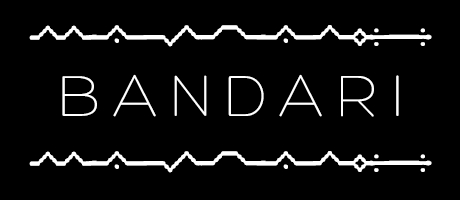
Fine hairs gathered from Vukhal and Pandeer are cleaned, spun and drawn taut across small looms, then knotted and turned to form the angular lines of Bandari script. A rise, dip, knot or crossing changes the shape of a character; pauses are held as spaces in the weave. Longer texts become narrow bands of language that can be rolled, carried, worn, hung from a wall, or sewn into larger cloth.
The material matters. Vukhal hair carries something of the hunt: companionship, danger and the wild places beyond the village. Pandeer hair speaks more of journeys, burdens carried and the long road home. A text woven from both holds the two together.
This is why Bandari writing tends toward a continuous line. The word is not placed upon the cloth. The word is the cloth.
Written Bandari came later: a quick way of reproducing the shapes of the weave with charcoal, pigment or stylus. Even there, the old structure remains. Letters bend like tensioned fibre. Dots recall knots and beads. Diamond forms preserve places where threads once crossed, opened or were bound together.
Important words may still be woven rather than written: names, promises, histories, blessings for travellers, accounts of a hunt, or words intended to outlive the person who made them. A family may possess pieces woven by hands generations dead.
To a Bandari, reading an old weaving is therefore something more intimate than reading a page.
Someone held every one of those words between their fingers.
Related
Adjust the site for this browser. Your choices are remembered on this device.
These controls improve presentation preferences; they are not a substitute for accessible content, structure, labels and keyboard behaviour.